
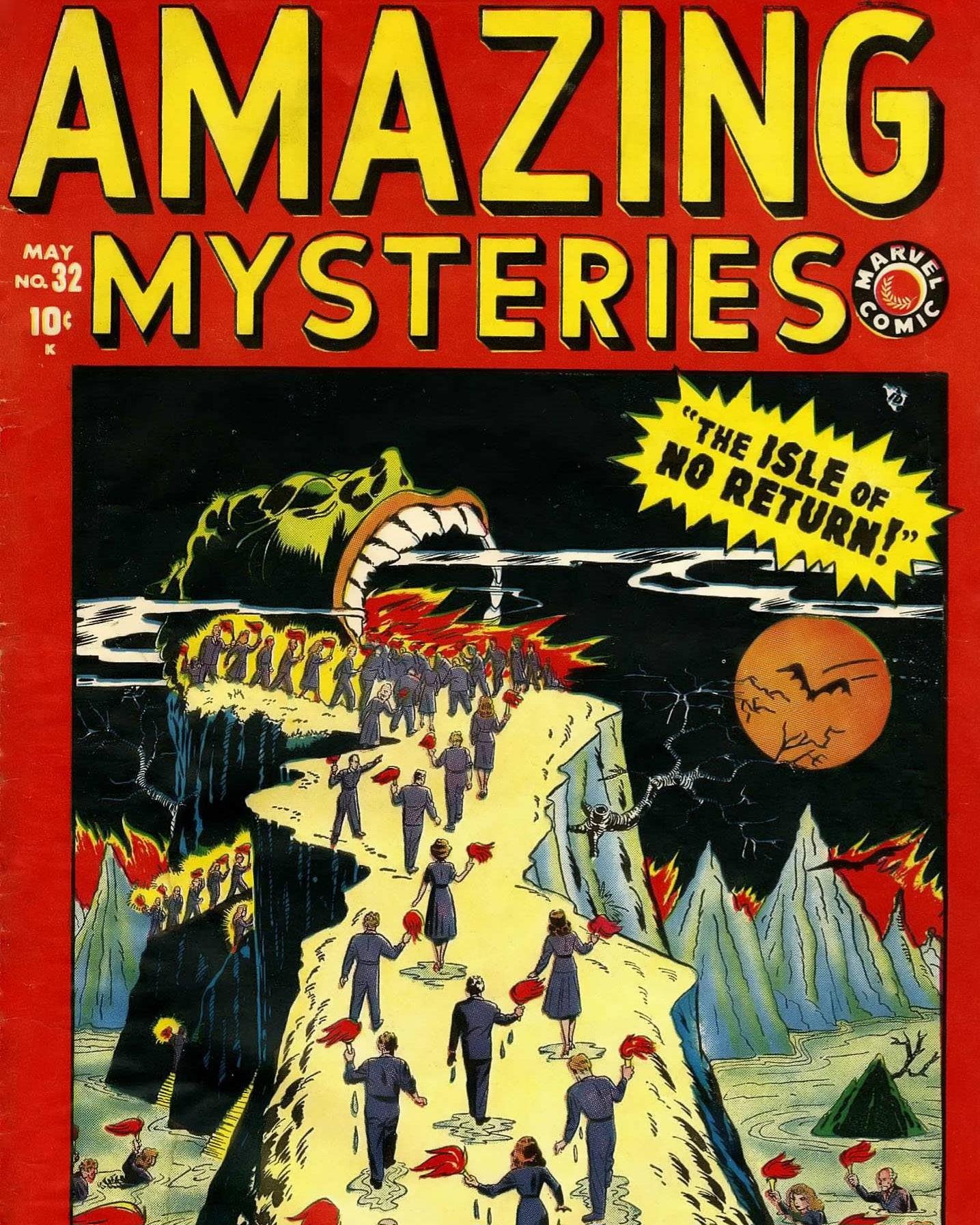
 Amazing Mysteries #32: Golden Age Hot Pick – Marvel’s First Horror Comic
CLICK HERE for Bronze Age Hot Pick: Warlock #12
Explore any red-highlighted links or comic covers to shop directly from all available eBay sellers now.
*This site contains affiliate links for which I may be compensated.
Amazing Mysteries #32 from 1949 is one of those Golden Age Marvel books that feels like it should already be sitting in a much louder collector conversation. It has the age. It has the rarity. It has the horror angle. It has the historical Marvel connection. And, most importantly, it has the kind of “wait, this was first?” status that collectors usually start chasing after the market has already woken up. This 1949 book is widely recognized as the first Marvel horror comic, and that alone gives it tremendous upside if Marvel Studios ever decides to go all in on horror in a way that feels bigger than a one-off experiment or a side-door genre tease.
That is the core of the speculation here. Marvel has spent years training audiences to care about cosmic wars, multiverse madness, street-level vigilantes, gods, monsters, aliens, witches, vampires, demons, and supernatural corners of the brand. Yet Marvel’s horror side still feels like a room in the mansion that has not been fully opened. If that door ever gets kicked off the hinges, Amazing Mysteries #32 becomes more than an obscure Golden Age oddity. It becomes the historical starting point for Marvel horror in comic book form. That is not hype. That is awareness.
The comic was published with a May 1949 cover date and an on-sale date recorded as February 19, 1949. It carried a 10-cent cover price, ran 36 pages, and was edited by Stan Lee. The issue’s cover feature is “The Isle of No Return,” a wonderfully grim Golden Age horror image with a massive demonic head, a blood-red burst from its mouth, torch-bearing figures moving toward doom, and a giant warning caption announcing “The Isle of No Return.” It looks exactly like the kind of cover that made parents in 1949 glance over their kid’s shoulder and wonder what in the world had happened to funny books.
The historical wrinkle gets even better because Amazing Mysteries did not begin with issue #1. The series continued the numbering from Sub-Mariner Comics #31, making Amazing Mysteries #32 a bizarre and fascinating genre pivot from one of Timely/Marvel’s major Golden Age superhero titles into horror and suspense. The Amazing Mysteries series ran only four issues, #32 through #35, from May 1949 through January 1950, and its numbering continued from Sub-Mariner Comics.
That numbering shift matters. It places this book right at the moment when Golden Age superheroes were fading and publishers were scrambling into other genres. Crime, romance, westerns, science fiction, and horror all started grabbing newsstand attention as the superhero boom cooled. Amazing Mysteries #32 sits in that strange transitional moment where Marvel was not yet the Marvel Universe we know, but the DNA was already mutating. A Sub-Mariner line turning into a horror anthology is exactly the kind of oddball publishing history collectors eventually rediscover.
The creator credits are also part of the appeal, even though several are listed with some historical uncertainty. Stan Lee is credited as editor. The cover for “The Isle of No Return!” has been credited with possible pencils by Marty Nodell, possible colors by Stan Goldberg, and unknown inks and lettering. That alone gives the book another Golden Age collector layer, connecting this early Marvel horror experiment to names that helped shape the broader comic book landscape.
Inside the issue, “The Thing at Chugamung Cove!” is listed as an 11-page horror-suspense story with possible pencils by Chic Stone, typeset lettering, and unknown script, inks, and colors. The story has an especially interesting historical footnote because it features versions of Stan Lee as “Lee Hart” and Martin Goodman as “Martin Mansfield,” while also being described as an unauthorized, slightly modified adaptation of H. P. Lovecraft’s “The Shadow Over Innsmouth.” That is a wild little piece of pre-code Marvel history buried inside what is already a major horror key.
“The Menace from the Past!” is listed as a 6-page horror-suspense story with pencils by Gene Colan, possible inks by George Klein, and possible lettering by Jon D’Agostino. That Gene Colan credit is another collector-friendly detail, considering how important Colan would become to Marvel’s later horror legacy through his work on titles like The Tomb of Dracula. The line from early Atlas-era suspense to the Bronze Age Marvel horror explosion becomes a little more interesting when a young Colan appears in the first Marvel horror comic.
The issue also includes the 2-page text story “The Isle of No Return,” with possible illustration by Marty Nodell, and “With Intent to Kill!,” a story that includes an appearance by The Witness. The Witness is not exactly sitting in the same mainstream recognition lane as Captain America, Namor, or the Human Torch, but that deep-cut Golden Age Marvel connection adds another historical wrinkle to the book.
The pre-code angle should not be overlooked either. Even in 1949, comics were already coming under fire for lurid covers and content, and this issue included a letter to readers and parents addressing the controversy before the later arrival of Fredric Wertham and the Comics Code era. That gives Amazing Mysteries #32 more than just “first horror comic” status. It places the book inside the broader cultural pressure building against horror and crime comics at the time.
The cover itself sells the entire point. This is not polite spooky mystery. This is Golden Age nightmare fuel: a death-march pathway, red skies, jagged landscapes, people walking toward a monstrous idol-like head, and the whole thing framed in that classic 1940s newsstand urgency. It has that rough, strange, slightly unhinged visual language that modern horror collectors love because it does not feel focus-grouped. It feels dangerous in the way pre-code horror is supposed to feel dangerous.
That is why this book has the kind of upside collectors should at least understand, even if they never get the chance to own one. Amazing Mysteries #32 is not just “old Marvel.” It is Marvel before Marvel became Marvel, experimenting with horror at the exact time the industry was shifting. It is a first issue, but not a traditional first issue. It is a horror key, but not one that casual MCU fans are talking about. It connects to Stan Lee, Martin Goodman, Gene Colan, Marty Nodell, Stan Goldberg, Chic Stone, George Klein, Jon D’Agostino, The Witness, Sub-Mariner numbering, pre-code controversy, and the birth of Marvel horror.
Its market history has already shown that serious collectors understand the book when higher-grade copies appear. A CGC 5.5 sold in January 2025 for $2,400, while the Promise Collection CGC 9.6 sold in 2021 for $26,400. That does not mean every copy is suddenly a retirement plan. It means the market already recognizes the book when the right copy surfaces. A total of 49 copies are graded by CGC. Only 4 sit in the Near Mint zone. One at 9.6, one at 9.2, and two at the 9.0 grade.
The bigger question is whether the mainstream collector market ever fully catches up to what this comic represents. Marvel horror has recognizable later keys. Tomb of Dracula #10 has Blade. Marvel Spotlight #5 has Ghost Rider. Werewolf by Night #32 has Moon Knight. But Amazing Mysteries #32 is much earlier. It is the root-system book. It is the first Marvel horror comic, published before the Code, before the Silver Age, before the modern Marvel Universe, and before horror became a reusable superhero-adjacent lane.
If Marvel Studios ever makes horror a real pillar instead of a side hallway, this book becomes a much louder conversation. Not because it features the next household-name character. Not because the cover will appear in a trailer. Not because it needs a cameo to validate it. Amazing Mysteries #32 matters because it is the beginning of Marvel horror on the printed page. That is the kind of history collectors should know before everyone else starts pretending they knew it all along.
-Jay Katz