
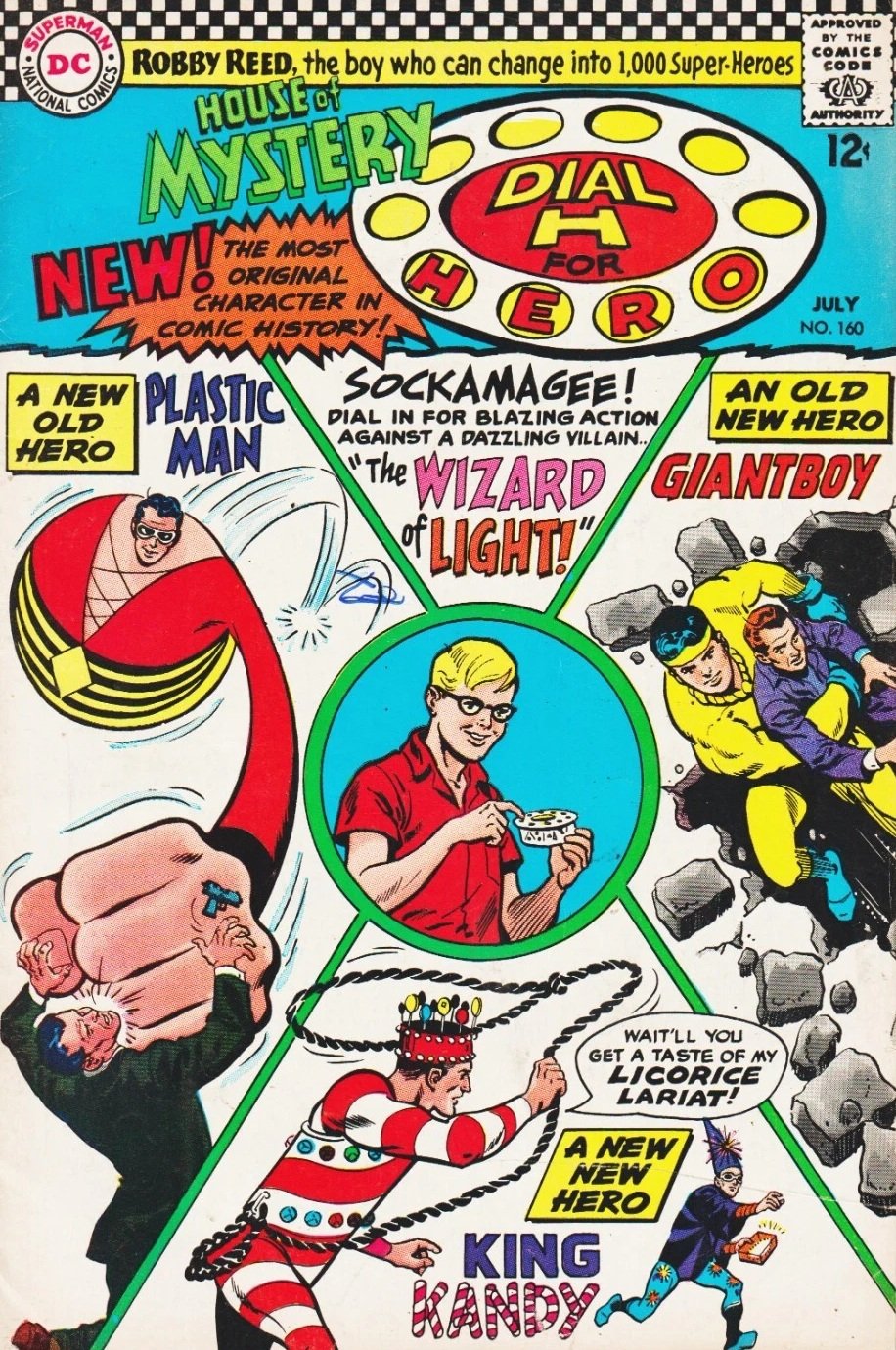
 Silver Age Hot Pick: House of Mystery #160
Click here for last week’s Bronze Age Hot Pick: Marvel Team-Up #53 1977
Explore any red-highlighted links or comic covers to shop directly from all available eBay sellers now.
*This site contains affiliate links for which I may be compensated.
House of Mystery #160 from 1966 is one of those Silver Age keys that feels like it should be louder in the collector market, but somehow it is still sitting there, quietly waiting for collectors to wake up. This is DC’s first Silver Age appearance of Plastic Man, and depending on how strict you want to get with comic book history, it is essentially the first DC appearance of Plastic Man as well. The issue features Robby Reed using the Dial H for Hero device and transforming into Plastic Man during the “Dial H for Hero” story, “The Wizard of Light.” The comic was written by Dave Wood, with art and cover art by Jim Mooney. The issue also includes a Martian Manhunter backup story by Jack Miller with art by Joe Certa.
The history here matters. Plastic Man did not begin life at DC Comics. He first appeared in Police Comics #1 in 1941, published by Quality Comics, and was created by the legendary Jack Cole. That debut is one of the great Golden Age introductions, with Cole building a character who was part superhero, part cartoon physics, part crime-comedy chaos machine. Plastic Man was not just another stretchy hero. He was Eel O’Brian, a criminal turned bizarrely flexible hero, and Cole’s work gave him a visual personality that still feels different from almost everything else in the genre.
Then came 1956. Quality Comics folded, and DC, then National Comics Publications, acquired many of the Quality character and title trademarks. That purchase brought characters like Blackhawk, G.I. Combat, and eventually Plastic Man under the DC umbrella. The funny part, because comic history loves being messy, is that Plastic Man did not immediately become a DC priority. The character had a Golden Age legacy, but DC let him sit before bringing him back into the Silver Age conversation. That is what makes House of Mystery #160 such a weirdly important collector book. It is not Police Comics #1. It is not the original birth of Plastic Man. But it is the moment DC finally puts Plastic Man into its Silver Age machinery.
And yes, the cover is pure Silver Age madness in the best possible way. “Robby Reed, the boy who can change into 1,000 super-heroes” sits right there at the top, then the cover throws Plastic Man, Giantboy, King Kandy, a villain called The Wizard of Light, and enough carnival-colored chaos at the reader to make modern variant covers look shy. Jim Mooney understood exactly what this book needed to be: loud, strange, kid-friendly, collector-friendly, and absolutely unmistakable from ten feet away. This is not a subtle cover. This is a DC Silver Age cover screaming, “We found something weird, and we’re going to sell it for twelve cents.”
Now let’s get into the numbers, because this is where the book gets very interesting. There are only 213 total graded copies of House of Mystery #160 on the census. That is shockingly low for a 1966 DC key tied to a major inherited character with Golden Age roots and modern media potential. Out of those, 75 graded copies sit in the Near Mint range, with only 4 copies reaching the highest 9.8 grade. For a comic that represents Plastic Man’s first Silver Age appearance and his early DC-era arrival, that population is not exactly screaming “overloaded market.”
The recent and current pricing makes the situation even stranger. A graded 9.4 recently sold for only $472. Current available copies are still sitting in very reasonable territory, including a 9.2 listed around $600 or best offer, a 7.0 around $197 or best offer, and even a 5.0 around $85 or best offer. For a Silver Age DC key connected to a character with this much history, that is the kind of pricing collectors should at least stop and think about before spending the same money chasing the twentieth modern ratio variant of the month.
The possible upside is where things get fun. James Gunn recently teased a photo with actor Matthew Lillard, and Lillard’s name has already sparked speculation around a possible DCU role. Reports have also noted that Lillard has joined Gunn’s Man of Tomorrow cast, with his role still undisclosed, and fan speculation has naturally drifted toward Plastic Man because, frankly, the optics are not hard to understand. Lillard has the timing, the facial elasticity, the oddball energy, and the exact type of unpredictable presence that could make Plastic Man work without turning him into a one-note joke. Nothing is confirmed, so let’s not pretend this is locked in. But if Plastic Man does enter the DCU in a meaningful way, House of Mystery #160 is exactly the kind of underpriced Silver Age key that could move fast.
And even if none of that happens, which is always possible because Hollywood rumors are where collector logic goes to get stretched thinner than Plastic Man himself, the book still stands on its own. This is a 1966 DC Silver Age key with a tiny graded census, a major Golden Age character connection, a historic Quality Comics-to-DC Comics bridge, and a cover that practically announces its own importance. It is affordable, available, and still sitting in a range that makes sense for collectors who like history before hype.
That is really the whole point. House of Mystery #160 does not need a movie announcement to matter. It already matters. A confirmed DCU Plastic Man would simply wake up the people who were not paying attention. For now, this is a very big key book hiding in plain sight, and the market has not punished anyone yet for being early. Speculation isn’t about hype, it’s about awareness. House of Mystery #160 is awareness wrapped in a twelve-cent Silver Age circus cover, and honestly, that is not a bad place to park collector money before the rest of the room starts stretching for it.
-Jay Katz