
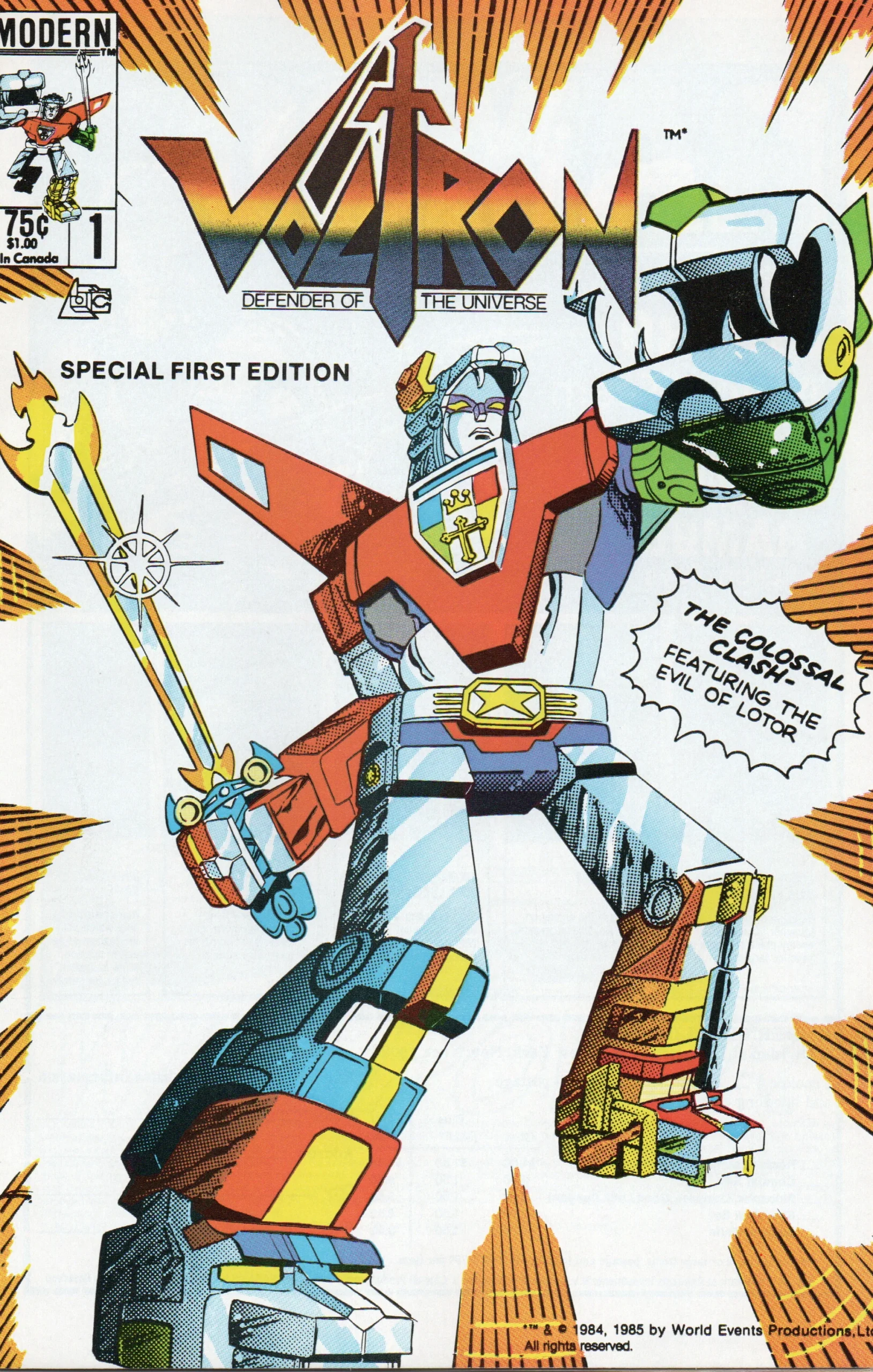
 Voltron #1
Modern Comics, 1984
Writer: Henry Vogel
Artists: Dick Ayers, Rich Ayers, Mac Fury
Cover Artists: Jim Fry, Mark McKenna
There are some Copper Age books that do not need a lot of complicated explanation. The book is either sitting in front of the market with a flashing red light on it, or everyone is going to pretend they “knew it all along” after the trailer drops. Voltron #1 from Modern Comics is one of those books.
This is the first appearance of Voltron in a comic book. That alone gives this comic a real seat at the speculation table. Not a maybe. Not a cute little nostalgic side note. A real seat. The kind of seat that gets much more interesting when Amazon MGM Studios is moving forward with a live-action Voltron feature, directed by Rawson Marshall Thurber, with Henry Cavill, Sterling K. Brown, Alba Baptista, Rita Ora, and others attached to the cast. Hasbro’s own announcement confirms Thurber as director, with the story by Thurber and screenplay by Ellen Shanman and Thurber, along with a cast led by Cavill, Sterling K. Brown, Alba Baptista, Rita Ora, and more.
That is where this book starts getting very interesting from a speculation standpoint. Voltron is not some forgotten property that needs a miracle to get noticed. The brand has been around for decades. The official Voltron timeline still anchors Voltron: Defender of the Universe in the 1984-1985 era, which matters because this is not a modern nostalgia invention pretending to be important. This is a legitimate 1980s pop culture machine that has already proven it can be revived for different generations.
The first comic book appearance becomes the collecting lane here. Toys have their own market. Animation cels have their own market. VHS nostalgia has its own weird little corner where people spend money on things they cannot even play anymore without digging through a closet for cables. But in comics, Voltron #1 is the entry point. The first comic appearance. That is the angle. That is the reason this book belongs in the conversation.
And right now, the prices are still in that zone where a speculator should at least be paying attention.
Recent raw near mint copies have sold in the $60 to $100 range. That is not pocket change for a book that sat ignored by many collectors for years, but it also is not the type of number that suggests the market has fully priced in a major live-action Voltron push from Amazon. Recent graded sales are also telling: CGC 9.2 around $100, CGC 9.4 around $120, CGC 9.6 around $280, and CGC 9.8 around $325. Those numbers, in our opinion, still look like buy-mode numbers when you factor in the current movie heat and the star power involved. Yes, Henry Cavill, we are looking at you. And yes, Sterling K. Brown, you too.
The key here is not that Voltron #1 is rare. It is not. Let’s not play that game. The CGC census reportedly lists 2,086 graded copies, and the graded population is very top heavy from 9.8 down to 9.0. That matters. It explains why a CGC 9.8 can sell at a semi-low number compared to what many people might expect from a first comic appearance tied to a major franchise. When too many high-grade copies exist, the top end gets pressure. That does not kill the speculation. It just means the ceiling has to be understood with a little common sense.
That is the part some speculators do not like to hear. Not every book with movie news suddenly becomes a rocket ship. Sometimes the census creates drag. Sometimes the trailer underwhelms. Sometimes the studio fumbles the tone. Sometimes the market runs too early and then cools before the actual release. Welcome to comic speculation, where the easiest money is usually made before everyone starts yelling about easy money.
But Voltron has something a lot of 1980s properties do not have. It has a clean visual concept. Five robotic lions forming one giant warrior. That is not hard to explain. That is not a strange mythology you need to decode through six Reddit threads and a 47-minute YouTube theory video. It is giant robots, teamwork, space fantasy, nostalgia, and a massive sword. Hollywood has spent more money on worse ideas. A lot more.
Amazon also appears to be positioning the film as a streaming release rather than a traditional theatrical rollout. Recent reports say the live-action Voltron movie is expected to go directly to Prime Video instead of theaters, with the film expected in 2027. That changes the speculation conversation a little bit. A theatrical release can create big box office headlines, but a Prime Video release can put the property directly in front of a massive audience at home. For a family-friendly sci-fi action property with built-in nostalgia, that is not exactly a terrible lane.
Now, the market will likely move in stages. The first stage is already happening: casting news, production updates, and collectors slowly realizing that Voltron #1 exists as the first comic appearance. The second stage comes with official images, teaser footage, or a trailer. That is when the casual money usually starts paying attention. The third stage is the release itself. That is where the book either keeps climbing because the film hits, or it pulls back because the market did what the market always does when hype outruns quality.
If the movie is a hit, and we think it has a very real chance to be, then sequels become part of the conversation. And sequels matter. A one-off movie can spike interest. A franchise can sustain it. That is the difference between a short-term flip and a longer-term hold. If Voltron lands with audiences, the first comic appearance becomes more than a nostalgia book. It becomes the first comic book entry point for a renewed screen franchise.
That is why the current graded numbers feel important. A CGC 9.8 at $325 does not scream overpriced when Henry Cavill and Sterling K. Brown are attached to a live-action version of one of the most recognizable 1980s animated properties. A CGC 9.6 at $280 feels tighter, because the gap between 9.6 and 9.8 is not massive enough to make every 9.6 an obvious buy without looking carefully. The 9.4 at $120 and 9.2 at $100 are interesting because they offer a lower buy-in point, especially if the market begins to chase graded copies after trailer traffic starts moving.
Raw near mint copies between $60 and $100 may be the most interesting lane for speculators willing to do the work. That means looking closely at spine ticks, white cover issues, corner wear, page quality, and that overall presentation. This is not a dark cover hiding defects in the shadows. White covers can be brutal. They show dirt, tanning, handling, and every little thing a seller tries to describe as “minor.” There is nothing minor about paying near mint money for a very fine copy because the seller took pictures with a potato under kitchen lighting.
The comic itself is also a pure nostalgia object. The cover says everything it needs to say. Voltron standing front and center, sword in hand, with the logo above and that “Special First Edition” callout sitting right there. It looks like 1984 in the best possible way. Not polished. Not overly designed. Not trying to be prestige. It is a licensed Copper Age comic designed to catch the eye of kids who were already watching the cartoon and probably begging for the toys. That is the charm. That is also the opportunity.
Modern Comics only produced a short three-issue Voltron series, and the original run is tied directly to the Lion Voltron television property. The Modern Comics series is generally listed as a three-issue limited series, with issue #1 titled “Willpower,” written by Henry Vogel with art credited to Ayers. Other comic databases also list the broader creator credits for issue #1 as Henry Vogel on writing, artists Rich Ayers, Mac Fury, and Dick Ayers, with cover artists Jim Fry and Mark McKenna.
That short run helps the book in a simple way. There is no complicated maze of early appearances to navigate. There are no twelve preview books, ashcans, convention editions, or retailer incentive variants making everyone scream at each other online. This is the first comic appearance. Period. That clarity matters.
Now, does that mean everyone should run out and pay whatever a seller asks by the time this article gets around? No. Absolutely not. That is how people get cooked. The market may react quickly. InvestComics does have influence in this space, and when a book like this gets highlighted, copies can start moving. Prices can vary upward for a bit simply because more eyes are on it. That is the heads up. Do not mistake movement for value every single time. Sometimes movement is value catching up. Sometimes movement is just the market getting loud.
The smartest play here is awareness. Watch raw copies. Watch graded gaps. Watch whether CGC 9.8s stay around that $325 area or begin disappearing. Watch whether 9.6 copies start getting repriced closer to 9.8s. Watch whether raw near mint copies move from $60-$100 into the $125-$175 range after more film material hits. That is where the signal will be. Not in someone yelling “undervalued” after they bought ten copies and suddenly found religion.
There is also a real difference between speculating and blindly believing every IP adaptation will work. Voltron could be a bust. Of course it could. Any film can miss. The tone could be wrong. The effects could look too digital. The story could be flat. The audience could shrug. The streaming release could land for a weekend and disappear into the endless scroll. That is the risk. And anyone telling you there is no risk is probably selling you something.
But there is a reason this book belongs in the Copper Age Hot Pick conversation. The ingredients are sitting right there: first comic appearance, major 1980s nostalgia, recognizable franchise, Amazon MGM backing, a live-action feature, a 2027 window, Rawson Marshall Thurber directing, and a cast with names that can pull attention outside the normal comic bubble. That is the kind of combination speculators look for before the wider market fully wakes up.
Voltron #1 is not about hype for the sake of hype. It is about positioning. It is about seeing a book that still has room to move before the trailer machine kicks in. It is about understanding that a first comic appearance tied to a major pop culture property can sit quietly for years, then suddenly become a lot less quiet when Hollywood starts spending real money.
We like this comic as a speculation play. We like the current entry points, especially compared to where this book could go if the movie hits. We like the Cavill and Sterling K. Brown factor. We like the simplicity of the first comic appearance angle. We do not love the top-heavy census, but that is not enough to dismiss the book. It just means the buy has to be smart.
Stay close to this one. Do your homework. Do not chase blindly. But do not be shocked if Voltron #1 starts forming its own market sword the closer we get to the first real trailer.
Speculation isn’t about hype. It’s about awareness.
Jay Katz